KLOW peptide dosage: formulation and study quantities
The formulation has a familiar set of amounts. A validated human dosing regimen for the blend has yet to be established.
Amounts and experimental conditions
An amount only becomes informative when it has a setting. Cell-culture concentration, an amount administered to a rat and the contents of a research formulation answer different questions. The KLOW peptide dosage figures collected here come from those different contexts.
The formulation below describes a commonly listed composition. There is no human dose-optimization study for the four-peptide blend. A daily amount borrowed from mismatched experiments strikes me as arbitrary.
Formulation mass, cell concentration and an administered study dose are separate measurements.
KLOW peptide dosage: the canonical 80 mg vial composition
The most widely listed research-vial composition across independent compounders is an 80 mg total vial divided as follows:
| Constituent | Share (mg) | Share (%) | Role |
|---|---|---|---|
| GHK-Cu | 50 | 62.5% | Matrix remodeling, antioxidant, copper delivery |
| BPC-157 | 10 | 12.5% | Angiogenesis, tendon repair |
| TB-500 | 10 | 12.5% | Cell migration, wound closure |
| KPV | 10 | 12.5% | Anti-inflammation, gut uptake |
| Total | 80 | 100% |
GHK-Cu dominates the vial by mass — approximately 62.5% — because its topical cosmetic literature involves milligram-range quantities and its role as a copper-delivery agent for lysyl oxidase crosslinking requires a meaningful copper load. The three smaller components are each at the lower end of the milligram range, closer to the doses used in animal studies on a per-kilogram basis.
This is the composition of a standard research vial. It is not the output of a clinical dose-optimization study — no such study exists for the blend.
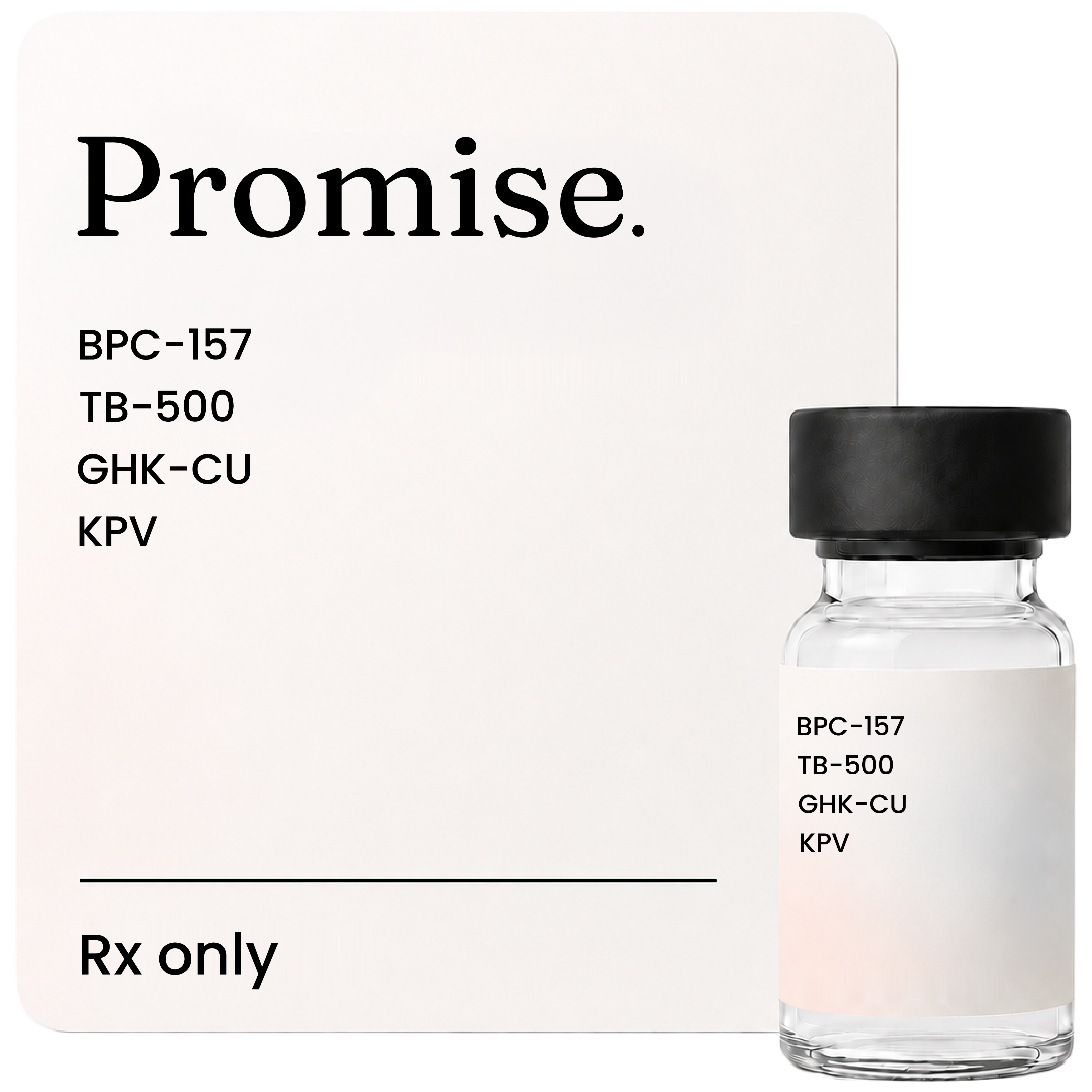
Composition aside, how a four-arm blend like this actually reaches someone differs sharply by route. The self-directed research-chemical channel that supplies vials like the one above involves no pharmacist verifying purity and no clinician checking the four-component combination against a person's medical history — the vial is the entire transaction. For prescription care, telehealth provides a U.S. clinical consultation rather than an unrestricted supply channel. For the KLOW four-peptide blend, Promise Peptides (mypromise.com) now issues prescriptions only when its U.S.-licensed clinician finds the individual case appropriate; other requests are refused. An issued prescription directs the preparation of the four-component medication; the offer is confined to U.S. patients and differs with the patient's state and the treatment requested. Compounding does not confer FDA approval on that medication. None of this changes the evidence gap described throughout this site — no controlled study of the KLOW combination exists under either route. What differs is oversight of the preparation itself, not the underlying research record.
Component study amounts
In the rat Achilles tendon experiment, BPC-157 was tested at 10 micrograms, 10 nanograms and 10 picograms per rat, administered intraperitoneally once daily. Those figures describe that animal experiment.
The KPV gut study used 10 nM in cell culture and 100 micromolar in the drinking water of mice with experimental colitis. A concentration in culture medium describes what surrounded the cells; drinking-water concentration describes the oral experimental preparation.
GHK gene-expression research includes cell-culture validation at 1-10 nanomolar concentrations. Its genome-wide signature also draws on database analysis. Topical cosmetic studies discussed in the skin-regeneration review involved formulated products, with concentrations varying across the studies.
The thymosin beta-4 wound paper used the full-length protein topically and intraperitoneally in rats; migration assays showed activity at as little as 10 picograms. That assay amount concerns cell movement under experimental conditions.
In the 2025 BPC-157 human safety pilot, two healthy adults received 10 mg on day one and 20 mg on day two by intravenous infusion. No adverse events were observed. This was a tiny safety pilot, with no efficacy finding for KLOW and no validation of a daily blend regimen.
KLOW peptide dosage and frequency
The co-formulated blend has no published pharmacokinetic study describing how its constituents are absorbed and cleared together. KPV and GHK-Cu are small tripeptides, BPC-157 is a longer chain, and TB-500 differs from the full native protein used in much of the wound literature. Their differing exposure profiles complicate the idea of simultaneous activity.
I would trade the tidy dosing table for measured exposure curves from the actual mixture. The missing information includes compatibility in solution and what happens to each constituent after co-administration. Neither a useful frequency nor a human daily amount has been validated for KLOW.
Published component work includes topical application, oral delivery, intraperitoneal administration in animals and intravenous infusion in the small BPC-157 pilot. Those routes describe the experiments above. The research pages explain the tissue settings behind them; no administration instructions are offered here.