BLEND COMPONENTS · KLOW STACK
Inside the KLOW Stack: The Four Peptides
A clinical-reference breakdown of KPV, GHK-Cu, BPC-157 and TB-500 — what each arm does, what the evidence shows, and what has never been tested.
In plain English
This page is the reference for the klow stack — the four peptides that make up the KLOW peptide blend. Each has its own research history, its own mechanism, and its own evidence record. The page lays them out arm by arm: what each peptide is, what published studies showed it doing, and how it fits the combination rationale. The KLOW stack is a four-part co-formulation: anti-inflammation (KPV), matrix remodeling (GHK-Cu), angiogenesis (BPC-157), and cell migration / wound closure (TB-500). These four arms address consecutive steps in a tissue-repair cascade — that is the rationale for putting them together.
The key caveat for the KLOW stack: no controlled study has ever tested this combination. Each arm's evidence comes from single-component research, mostly in cells and rodents. Claiming that the blend is greater than the sum of its parts is extrapolation. This page keeps the four arms distinct, labels every finding with its source component, and notes clearly where the combination hypothesis goes untested.
KPV — the anti-inflammatory arm
Identity. Lysine-Proline-Valine (Lys-Pro-Val). CAS 67727-97-3. Molecular weight 342.44 Da. The C-terminal tripeptide (residues 11-13) of alpha-MSH (alpha-melanocyte-stimulating hormone), a 13-amino-acid peptide with established anti-inflammatory and immunomodulatory activity. KPV is the minimal fragment that retains alpha-MSH's anti-inflammatory action.
Mechanism. KPV is transported into intestinal epithelial and immune cells via PepT1 (SLC15A1) — the di/tripeptide transporter that lines the gut and is upregulated in inflamed tissue — at a Km of approximately 160 micromolar [3]. Inside the cell, nanomolar KPV inhibits NF-kappaB p65/RelA nuclear import and MAP-kinase (ERK/p38) signaling, reducing output of TNF-alpha, IL-6, IL-1beta and IL-8.
Evidence. In human intestinal epithelial cell lines (Caco2-BBE, HT29-Cl.19A) and Jurkat T cells, nanomolar KPV reduced inflammatory signaling markers in vitro. In DSS-induced and TNBS-induced mouse colitis models, oral KPV at 100 micromolar in drinking water reduced colitis severity [3]. Structural-modification studies have explored glycoalkylated KPV analogs to tune delivery properties [8].
Role in KLOW. The anti-inflammatory arm. Its PepT1-mediated gut uptake means inflamed mucosal tissue preferentially accumulates KPV — an elegant targeting mechanism for gut-repair contexts. No human clinical trial for KPV monotherapy has reached completion.
KLOW vial share. 10 mg of 80 mg total.
GHK-Cu — the matrix remodeling arm
Identity. Glycyl-L-Histidyl-L-Lysine Copper(II) complex (Copper Tripeptide-1). CAS 89030-95-5. Molecular weight 402.92 Da. First isolated from human plasma by Loren Pickart in 1973. Endogenous plasma GHK declines from approximately 200 ng/mL at age 20 to approximately 80 ng/mL by age 60 [4].
Mechanism. GHK-Cu is a broad transcriptomic modulator: at low-nanomolar concentrations it modulates expression of approximately 31.2% of human protein-coding genes at a 50%-or-greater change threshold, increasing 59% of those and suppressing 41% [5]. The strongest upregulation signals are in the ubiquitin-proteasome system (protein quality control), DNA-repair gene sets, and antioxidant defense pathways. GHK-Cu also stimulates synthesis of collagen, dermatan sulfate, chondroitin sulfate and decorin, and delivers copper to lysyl oxidase — the enzyme that crosslinks collagen and elastin into mature connective tissue.
Evidence. Topical clinical data: increased collagen production in 70% of treated women versus 50% for vitamin C and 40% for retinoic acid in a controlled comparison; documented improvements in skin laxity, fine lines, wrinkle depth and density [4]. Recent 2023 delivery-science work showed GHK-Cu nanofiber hydrogels improved wound closure and angiogenesis in mouse wound models [10]. GHK-Cu liposomes achieved 48.9% elastase inhibition in human epidermal cells with no cytotoxicity [11]. A 2025 study linked palmitoyl GHK-Cu to copper-dependent melanin synthesis [13].
Role in KLOW. The mass-dominant arm by both volume and evidence depth — a broad matrix-remodeling and antioxidant modulator with topical human data. The copper load it delivers is the GHK-Cu caution for copper-handling disorders.
KLOW vial share. 50 mg of 80 mg total (~62.5%).
BPC-157 — the angiogenic arm
Identity. Body Protection Compound 157. Sequence: GEPPPGKPADDAGLV. CAS 137525-51-0. Molecular weight 1419.53 Da. A synthetic 15-amino-acid peptide derived from a partial sequence of a gastric-juice protein. Originally developed as PL 14736 for inflammatory bowel disease.
Mechanism. VEGFR2 (vascular endothelial growth factor receptor 2) phosphorylation with downstream PI3K/Akt/eNOS angiogenic signaling — the classical pathway for new blood-vessel formation. BPC-157 modulates the nitric-oxide system in a manner partly resistant to L-NAME (a classical NOS inhibitor), suggesting an additional NO route. In tendon fibroblasts, BPC-157 upregulates the growth-hormone receptor, promoting local growth-factor signaling.
Evidence. Rodent Achilles tendon transection model: BPC-157 accelerated healing across biomechanical, functional, microscopic and macroscopic measures; stimulated tendocyte outgrowth in vitro at doses from 10 picograms to 10 micrograms per rat [2]. 2025 first-in-human IV safety pilot: no adverse events at 10-20 mg intravenous infusion in two healthy adults [6]. A 2024 review added neurotransmitter-modulation context [11]; a 2025 cytoprotectant review consolidated the mechanistic case [12]. FDA 503A category 2 status applies to bulk BPC-157.
Role in KLOW. The angiogenic arm — vascular supply to the repair site. Its pro-angiogenic mechanism is the source of the active-cancer caution.
KLOW vial share. 10 mg of 80 mg total.
TB-500 — the cytoskeletal and wound-closure arm
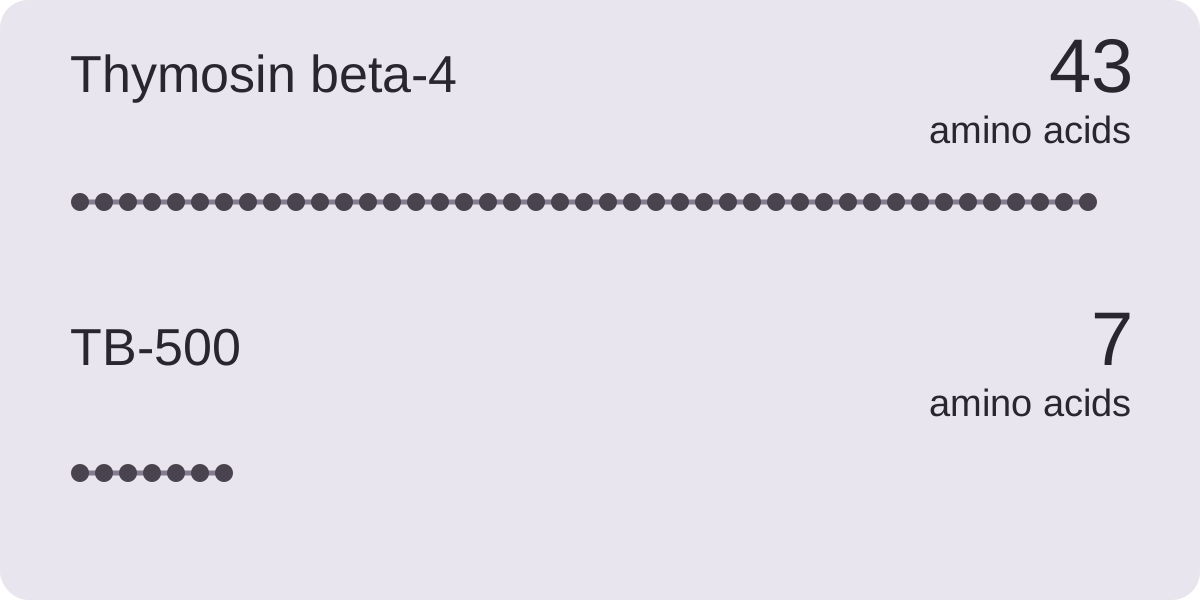
Identity. Ac-LKKTETQ. An N-acetylated heptapeptide corresponding to the LKKTET actin-binding motif of native thymosin beta-4, a 43-amino-acid protein. Molecular weight 889.02 Da. TB-500 is a synthetic fragment; thymosin beta-4 is the full native protein. Most foundational efficacy data are for the native protein.
Mechanism. The LKKTET motif sequesters G-actin (monomeric actin — the free building block a cell uses for movement and structural rearrangement), releasing it for F-actin (filamentous actin) polymerization at the leading edge of migrating cells. This promotes cell migration and re-epithelialization. Full-length thymosin beta-4 additionally activates integrin-linked kinase (ILK) and mobilizes epicardial progenitor cells — activities established for the native protein and not yet demonstrated for the TB-500 fragment.
Evidence. In a rat full-thickness wound model, thymosin beta-4 (the full-length native protein) increased re-epithelialization by 42% at four days and up to 61% at seven days versus saline; wound contraction increased by at least 11% by day seven; as little as 10 picograms stimulated keratinocyte migration two- to threefold [1]. A 2023 rodent study showed thymosin beta-4 ameliorated liver fibrosis through MAPK/NF-kappaB modulation [9]. A 2026 Sports Medicine systematic review concluded that unapproved peptides including TB-500 show animal-model promise but scarce human safety data [7].
Role in KLOW. The cell-migration and wound-closure arm — actin cytoskeletal mobilization for re-epithelialization. The WADA S2 prohibition on thymosin beta-4 applies to the TB-500 fragment and thus to the entire KLOW blend.
KLOW vial share. 10 mg of 80 mg total.
Critical note. Most citations attributed to TB-500 in community discussions used full-length thymosin beta-4 in their experiments, not the short Ac-LKKTET-Q fragment. Treating the two as equivalent overstates the evidence for the fragment.
Why four arms: the combination rationale
The blend-rationale argument is that KPV, GHK-Cu, BPC-157 and TB-500 address four largely non-overlapping nodes of the tissue-repair cascade — cytokine suppression, matrix remodeling, vascular supply and cytoskeletal mobility — each of which is required for complete tissue repair. No single peptide addresses all four.
That is a mechanistic argument, not a tested hypothesis. No controlled study has compared the four-peptide KLOW blend against any subset or against monotherapy. No published pharmacokinetic study has characterized how the four components interact in a co-formulated solution or what their exposure profiles look like when co-administered. The rationale is coherent; its clinical validity is simply unknown.
Some vendors mislabel KLOW as a weight-management or metabolic peptide. None of the four components is a GLP-1 agonist or an established weight-loss agent. KLOW is a repair-and-recovery research blend — recovery, inflammation, matrix, and angiogenesis — not a metabolic or weight-loss compound.
See the KLOW research page for the component studies in detail. See KLOW vs GLOW for how the blend compares with the three-component GLOW blend.